Google's AI Mode Just Got Connected Apps: Here's What It Means for AI Agents
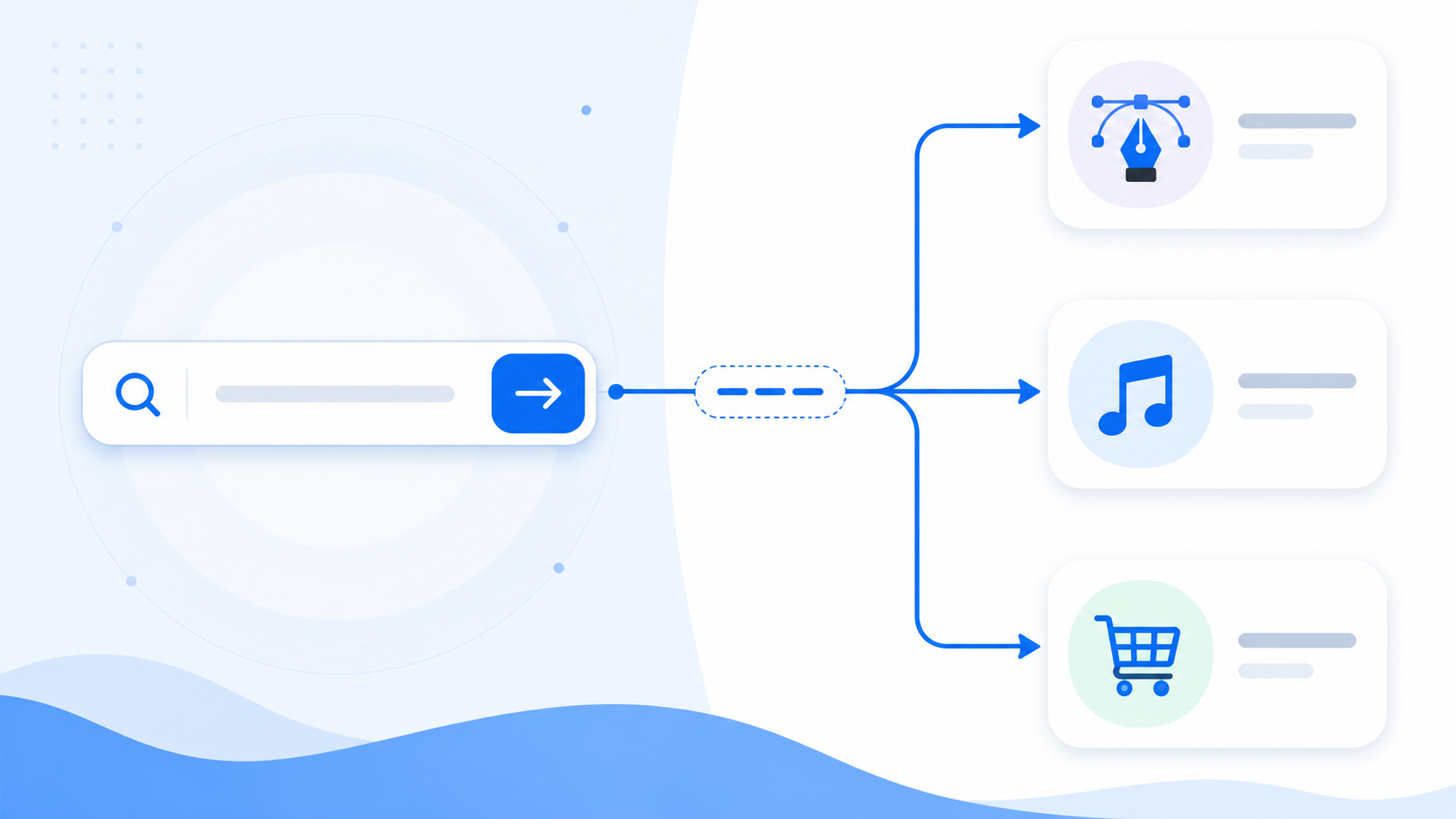
Google Search AI Mode Is Starting to Act, Not Just Answer
Google just gave Search's AI Mode something it didn't have before: the ability to act, not just answer.
Starting this week in the US, AI Mode can connect to:
- Canva
- YouTube Music
- Instacart
AI Mode can pass a prompt to each service and get back a design option, a saved playlist, or a ready-to-check-out cart.
You never leave the search box, but the work actually happens somewhere else.
For anyone building with AI agents, this deserves more attention than the feature list might suggest.
It's not really a shopping story or a music story.
It's a case study in how a company with billions of users decided to scope agent permissions in production — and that scoping is the interesting part.
What Actually Shipped
The rollout is narrow by design:
- Three partners
- One country
- One language
- Three specific workflows
Canva
Canva takes a description of a project, such as a party flyer, and returns template options generated inside Canva's own system.
Search supplies the starting prompt.
Canva remains the place where the actual design work happens.
YouTube Music
YouTube Music goes a step further.
AI Mode can:
- Turn a prompt into a playlist
- Show the playlist inline as a card
- Save it to the user's library
- Hand off playback to the YouTube Music app
That gives AI Mode creation capabilities and a limited library action, but not full control of the user's account.
Instacart
Instacart keeps the tightest boundary.
AI Mode can build a cart from a grocery prompt, but checkout remains entirely inside Instacart's interface.
Google's AP2 payment protocol used a similar model last year through a signed "Cart Mandate" that records user approval.
The pattern separates:
- The AI's job: Assemble the request
- The human's job: Authorize the transaction
The Direction of the Integration Has Changed
None of these categories are completely new for Google.
Earlier in 2026, Google tested Canvas-style creation tools in AI Mode.
It also rolled out opt-in Gmail and Photos access so Search could use personal information as context and expanded restaurant booking capabilities to additional countries.
What's different here is the direction of the integration.
Services like Gmail and Photos feed information into Search.
Canva, YouTube Music, and Instacart take instructions out of Search and into another product's workflow.
That distinction matters.
The Design Pattern Worth Noticing
Strip away the branding and there's a fairly disciplined agent architecture underneath this launch.
Google isn't handing AI Mode a general set of credentials and letting the model improvise inside three different applications.
Instead, each connection appears to represent a defined, bounded workflow.
The basic pattern looks like this:
- A specific type of prompt goes in.
- A predefined action is triggered.
- A specific type of output comes back.
- The partner application retains control over sensitive operations.
That includes things such as:
- Account changes
- Payments
- Saved assets
- Final authorization
This is meaningfully different from:
Give the model broad tool access and trust it to behave.
It's closer to how a careful engineering organization might design permissions for a junior employee:
- Narrow scopes
- Explicit checkpoints
- Limited privileges
- Clear ownership of sensitive actions
- No ambiguity around final authorization
Google hasn't publicly explained all of the technical plumbing behind these handoffs.
But the visible architecture follows a recognizable pattern:
Prompt in → bounded action → defined result → sensitive operations remain controlled by the destination service
That's a pattern any team building AI agents should pay attention to.
Why These Three Apps Make Sense
The architecture may also explain why Google started with Canva, YouTube Music, and Instacart.
Each application has a relatively well-defined action that is easy to constrain.
Canva
Action: Generate a design.
YouTube Music
Action: Create or save a playlist.
Instacart
Action: Populate a shopping cart.
These workflows have clear boundaries.
Compare that with applications such as:
- Calendars
- Messaging
- Financial tools
- Enterprise systems
The number of possible actions increases dramatically, and mistakes can carry greater consequences.
That may help explain why Google has treated access to more personal services as a separate, opt-in Personal Intelligence capability rather than simply exposing those systems through the same connected-app model.
Google Is Late, Not First
Google isn't introducing the idea of an AI assistant that interacts with other applications.
Other AI platforms already support third-party integrations.
Examples include:
- ChatGPT
- Claude
- Gemini
Google's Gemini app has also supported connections with external services for some time.
What's changing is that Google Search itself is now receiving similar capabilities.
And that matters.
Search operates at enormous scale.
Every search query potentially becomes a candidate for a new question:
Should AI answer this request, or should it perform an action?
That's a much larger shift than simply adding another chatbot integration.
Google has said additional partners are coming, but it hasn't publicly named all of them or provided a detailed rollout schedule.
That suggests the company may still be evaluating how these initial integrations perform before expanding the model significantly.
What to Watch Next
A few developments will help determine whether this becomes a real platform shift or remains a limited experiment.
1. How Quickly Google Adds Partners
Three applications look like a pilot.
A much larger ecosystem would start to look like a platform.
Watch how quickly the partner list expands.
2. Whether the Permission Model Holds
The bounded-permission model is relatively straightforward when AI Mode interacts with a small number of services.
The architecture becomes more complicated as additional services gain access to:
- Personal data
- Financial transactions
- Communications
- Documents
- Enterprise applications
- Account settings
The key question is whether Google maintains the same narrow permission model as the ecosystem grows.
3. Whether Developers Get Access to the Integration Layer
Right now, the integrations appear to be part of a curated Google ecosystem.
The larger question is whether Google eventually exposes something resembling:
- An API
- An SDK
- A partner framework
- An agent protocol
- A marketplace
- A standardized action schema
That decision could determine whether this remains primarily a Google-controlled feature or becomes an ecosystem that outside developers can build against.
The Bigger Takeaway
For now, this is better viewed as a signal than as a platform most developers can immediately build against.
The interesting part isn't simply that a user can generate a playlist or build a grocery cart from Google Search.
The more important development is the architecture underneath it.
One of the world's largest software companies is putting AI agents in front of a massive consumer audience while deliberately limiting what those agents are allowed to do.
The pattern is straightforward:
Give the agent enough permission to complete the useful part of the workflow, but keep sensitive actions behind clearly defined boundaries and human authorization.
For teams designing their own AI agents, that's a reasonable architecture to study.